
A Comprehensive Guide to Simple, Compound, and Complex Sentences with Examples
I. Introduction
Sentence structure is the foundation of effective communication. Whether you’re writing an essay, sending an email, or having a conversation, your ability to construct clear and coherent sentences plays a crucial role in conveying your message. In this comprehensive guide, we will explore the intricacies of simple, compound, and complex sentences. By understanding the characteristics, examples, transformation techniques, and rules of these sentence types, you will gain the necessary tools to master sentence structures and enhance your communication skills.
II. Simple Sentences
A. Definition and characteristics
- A simple sentence consists of one independent clause.
- It expresses a single idea and stands alone as a complete thought.
- Simple sentences are the building blocks of more complex sentence structures.
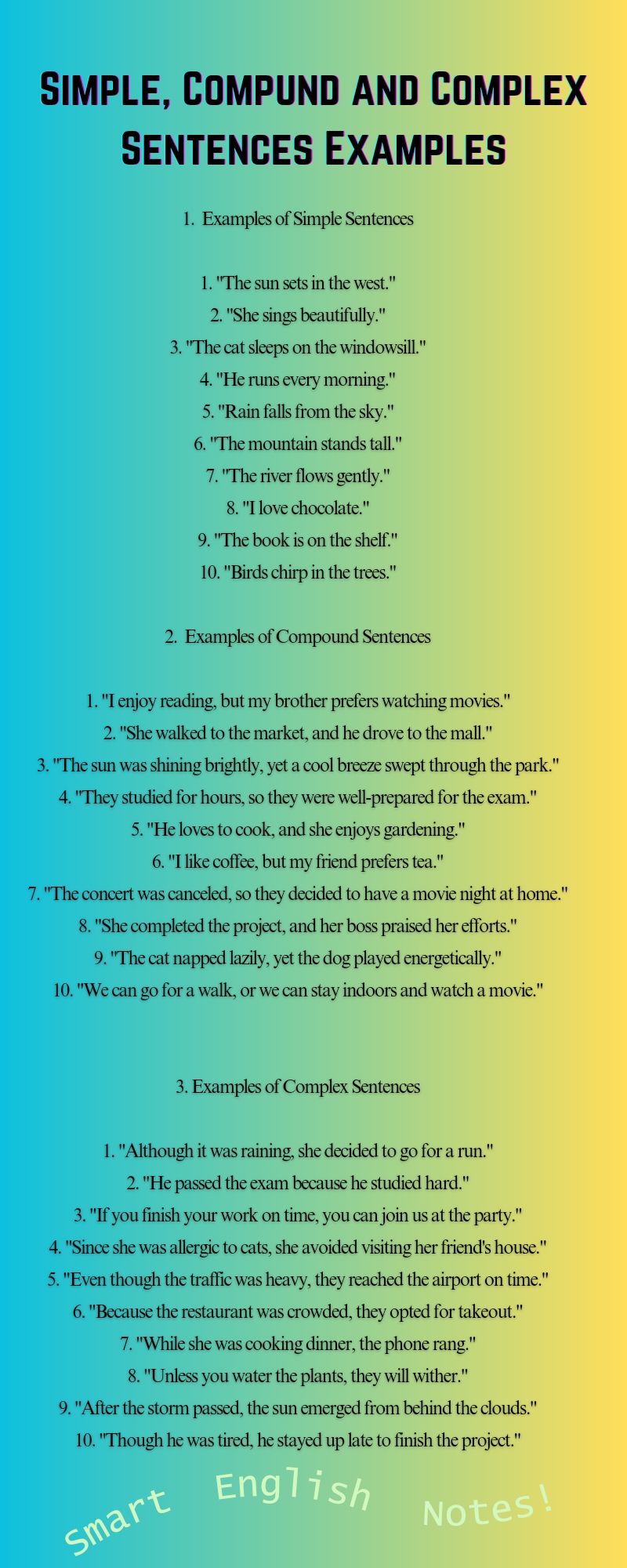
B. Examples of simple sentences
- “I love to read books.”
- “She runs every morning.”
- “He ate dinner.”
- “The cat stretched lazily on the windowsill.”
- “Sunflowers bloomed in the golden fields.”
- “Laughter echoed in the quiet library.”
C. Importance of simplicity in communication
- Simple sentences are straightforward and easy to understand.
- They provide clarity and directness, making your message more accessible to your audience.
- By utilizing simple sentences, you can effectively convey information and avoid confusion caused by convoluted sentence structures.
III. Compound Sentences
A. Definition and characteristics
- A compound sentence is composed of two or more independent clauses.
- These clauses are connected by coordinating conjunctions such as “and,” “but,” or “so.”
- Compound sentences offer a way to express multiple related ideas in a single sentence.
B. Examples of compound sentences
- “I went to the store, and I bought some groceries.”
- “She likes to sing, but she is shy about performing.”
- “He studied hard, so he passed the exam.”
- “She was tired, but the adrenaline kept her going.”
- “He studied diligently, and his grades improved significantly.”
- “The rain poured, so we decided to stay indoors.”
C. Coordinating conjunctions and their role
- Coordinating conjunctions join independent clauses of equal importance.
- They serve as signposts, signaling the relationship between the clauses.
- Some common coordinating conjunctions include “and,” “but,” “or,” and “so.”
D. Rules for creating compound sentences
- To create a compound sentence, you must have two or more independent clauses.
- Each independent clause should express a complete thought.
- Use a comma before the coordinating conjunction to separate the independent clauses.
IV. Complex Sentences
A. Definition and characteristics
- A complex sentence consists of one independent clause and at least one dependent clause.
- Dependent clauses provide additional information or context to the independent clause.
- Complex sentences allow for more depth and complexity in expressing ideas.
B. Examples of complex sentences
- “Although it was raining, she went for a walk.”
- “He studied hard because he wanted to succeed.”
- “I will go to the party if I finish my work on time.”
- “Although the movie was captivating, he couldn’t stay awake.”
- “Since she had a busy schedule, she delegated some tasks to her assistant.”
- “If you want to succeed, you must be persistent in your efforts.”
C. Subordinating conjunctions and their role
- Subordinating conjunctions introduce dependent clauses and establish a relationship between ideas.
- Common subordinating conjunctions include “although,” “because,” “if,” and “since.”
- These conjunctions help create complex sentence structures by connecting dependent and independent clauses.
D. Rules for creating complex sentences
- Begin the complex sentence with the dependent clause, followed by a comma before the independent clause.
- Ensure that the dependent clause cannot stand alone as a complete thought.
- Use appropriate subordinating conjunctions to clarify the relationship between the clauses.
V. Transformation of Sentences
A. Converting simple sentences to compound sentences
- To transform a simple sentence into a compound sentence, add another independent clause.
- This additional independent clause can provide further information or present a contrasting idea.
- The coordinating conjunctions “and,” “but,” or “or” can be used to connect the independent clauses.
B. Converting simple sentences to complex sentences
- Transforming a simple sentence into a complex sentence involves adding a dependent clause.
- The dependent clause provides additional context or background information to the independent clause.
- Use subordinating conjunctions like “although,” “because,” or “if” to establish the relationship between the clauses.
C. Transforming compound sentences into complex sentences and vice versa
- Transforming a compound sentence into a complex sentence can be done by converting one of the independent clauses into a dependent clause.
- This adds more complexity and nuance to the sentence structure.
- Similarly, a complex sentence can be transformed into a compound sentence by separating the independent clauses with coordinating conjunctions.
VI. Practice Exercises
A. Interactive examples for readers to practice sentence transformation
- Exercise 1: Convert the following simple sentence into a compound sentence by adding an independent clause:
- “She baked a cake.”
- Exercise 2: Transform the following simple sentence into a complex sentence by adding a dependent clause:
- “He loves to play basketball.”
- Exercise 3: Convert the following compound sentence into a complex sentence by creating a dependent clause:
- “I enjoy reading, and I also like painting.”
- Exercise 4: Combine the following simple sentences into a compound sentence:
- “She finished her homework.”
- “He went to the gym.”
- Exercise 5: Transform the following simple sentences into complex sentences:
- “They planted flowers.”
- “She visited the museum.”
- Exercise 6: Convert the following compound sentence into a complex sentence:
- “I enjoy hiking, and I also like camping.”
- Exercise 7: Create a compound sentence by adding an independent clause to the following simple sentence:
- “He played the piano.”
- Exercise 8: Transform the following compound sentence into two simple sentences:
- “She spoke eloquently, and the audience applauded.”
- Exercise 9: Combine the following simple sentences into a complex sentence:
- “The rain began.”
- “We decided to stay indoors.”
- Exercise 10: Convert the following complex sentence into a simple sentence:
- “Although it was late, he continued working on his project.”
- Exercise 11: Create a complex sentence by adding a dependent clause to the following simple sentence:
- “She enjoys photography.”
- Exercise 12: Combine the following simple sentences into a compound sentence:
- “He traveled to Paris.”
- “He explored the Louvre Museum.
Answers
Exercise 1
- Original: “She baked a cake.”
- Transformed: “She baked a cake, and her friends joined the celebration.”
Exercise 2
- Original: “He loves to play basketball.”
- Transformed: “Because he loves to play basketball, he joined the local basketball league.”
Exercise 3:
- Original: “I enjoy reading, and I also like painting.”
- Transformed: “While I enjoy reading, I also like painting.”
Exercise 4:
Combine the following simple sentences into a compound sentence:
- “She finished her homework, and he went to the gym.”
Exercise 5:
Transform the following simple sentences into complex sentences:
- “After they planted flowers, they enjoyed the colorful garden.”
- “When she visited the museum, she discovered fascinating exhibits.”
Exercise 6:
Convert the following compound sentence into a complex sentence:
- “Although I enjoy hiking, I also like camping.”
Exercise 7:
Create a compound sentence by adding an independent clause to the following simple sentence:
- “He played the piano, and the audience applauded.”
Exercise 8:
Transform the following compound sentence into two simple sentences:
- “She spoke eloquently. The audience applauded.”
Exercise 9:
Combine the following simple sentences into a complex sentence:
- “When the rain began, we decided to stay indoors.”
Exercise 10:
Convert the following complex sentence into a simple sentence:
- “Despite the late hour, he continued working on his project.”
Exercise 11:
Create a complex sentence by adding a dependent clause to the following simple sentence:
- “Because she enjoys photography, she always carries her camera.”
Exercise 12:
Combine the following simple sentences into a compound sentence:
- “He traveled to Paris, and he explored the Louvre Museum.”
Feel free to ask if you have any questions or if you’d like additional explanations for any of the exercises!
VII. Common Mistakes to Avoid
A. Errors in sentence structure
- Run-on sentences that lack proper punctuation or conjunctions.
- Fragmented sentences that are incomplete or lack subjects or verbs.
- Unbalanced sentence structures that disrupt the flow of information.
B. Misuse of conjunctions
- Confusing coordinating conjunctions with subordinating conjunctions.
- Overusing conjunctions, resulting in wordy and convoluted sentences.
- Neglecting to use conjunctions when needed, leading to incomplete thoughts.
C. Clarity issues in complex sentences
- Lack of clarity due to misplaced or vague dependent clauses.
- Poorly constructed subordinate clauses that do not clearly convey the intended meaning.
- Failure to provide clear transitions between independent and dependent clauses.
VIII. Tips for Effective Writing
A. Balancing sentence types for variety
- Incorporate a mix of simple, compound, and complex sentences to add variety to your writing.
- Varying sentence structures keeps the reader engaged and enhances the flow of your ideas.
- Experiment with different sentence lengths and formats to create a dynamic and engaging writing style.
B. Using appropriate sentence structures in different contexts
- Consider the purpose and tone of your writing when choosing sentence structures.
- Simple sentences are ideal for conveying straightforward information or instructions.
- Complex sentences are more suitable for expressing complex ideas or exploring nuanced concepts.
IX. Conclusion
A. Recap of simple, compound, and complex sentences
- Simple sentences consist of one independent clause and are the foundation of communication.
- Compound sentences combine multiple independent clauses using coordinating conjunctions.
- Complex sentences combine independent and dependent clauses to provide additional context.
B. Importance of mastering sentence structure for improved communication
- A strong grasp of sentence structures enables clear and effective communication.
- Understanding how to use simple, compound, and complex sentences enhances readability and comprehension.
- Mastering sentence structure empowers writers to express their thoughts accurately and eloquently.
C. Encouragement for continued practice and learning
- Sentence structure is a skill that develops through practice and refinement.
- Regularly reviewing and applying the rules and techniques discussed in this guide will strengthen your command of sentence structures.
- Embrace the opportunity to enhance your communication skills and continue learning to become a proficient and confident writer.