
Grammar is a set of rules that govern how words in a language are combined to form sentences. It consists of studying syntax, punctuation, and morphology. Sentence construction employs a variety of grammatical structures, each of which serves a particular function. Some common grammatical structures include simple sentences, compound sentences, complex sentences, and compound-complex sentences. In addition, there are a variety of clauses, phrases, and other elements that can be used to construct more complex and nuanced sentences. Understanding and mastering these grammatical structures will enable you to communicate more effectively and express yourself in speaking and writing with greater clarity.
Here are some examples of grammatical structures along with their explanations:
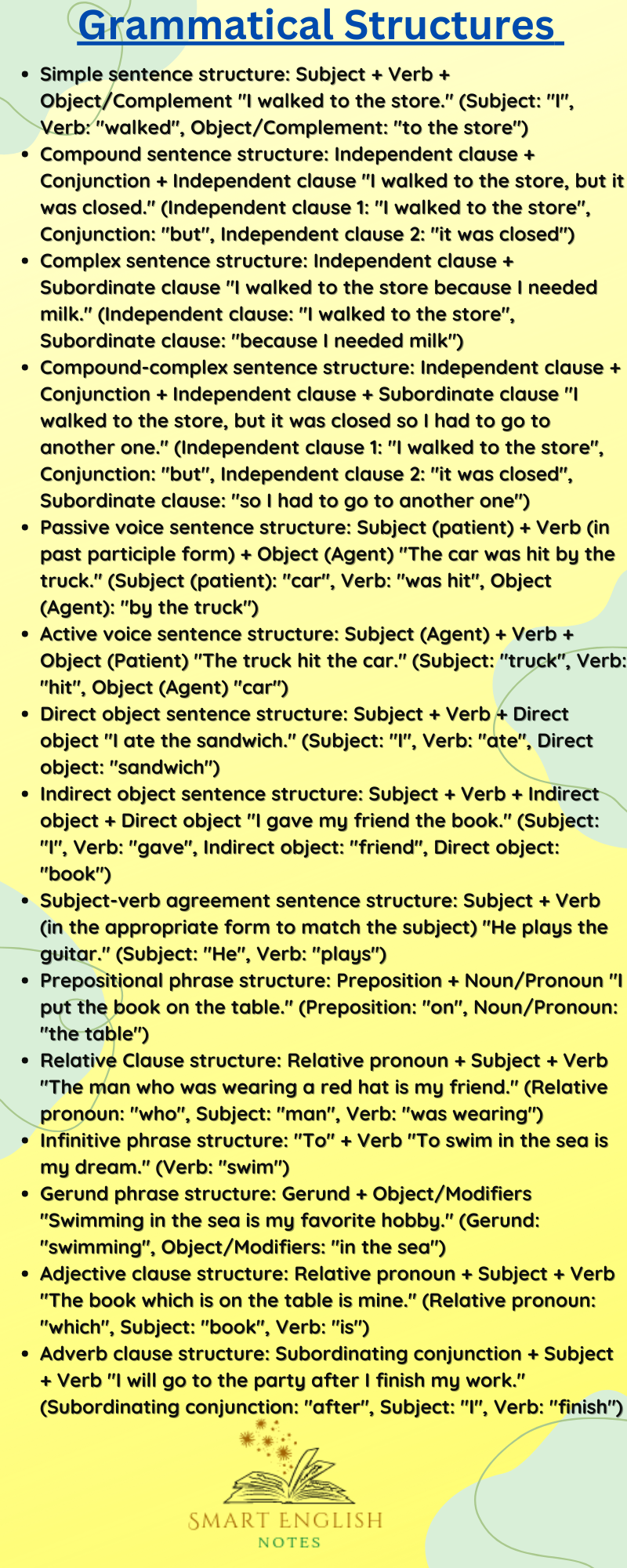
- Simple sentence structure: Subject + Verb + Object/Complement “I walked to the store.” (Subject: “I”, Verb: “walked”, Object/Complement: “to the store”)
- Compound sentence structure: Independent clause + Conjunction + Independent clause “I walked to the store, but it was closed.” (Independent clause 1: “I walked to the store”, Conjunction: “but”, Independent clause 2: “it was closed”)
- Complex sentence structure: Independent clause + Subordinate clause “I walked to the store because I needed milk.” (Independent clause: “I walked to the store”, Subordinate clause: “because I needed milk”)
- Compound-complex sentence structure: Independent clause + Conjunction + Independent clause + Subordinate clause “I walked to the store, but it was closed so I had to go to another one.” (Independent clause 1: “I walked to the store”, Conjunction: “but”, Independent clause 2: “it was closed”, Subordinate clause: “so I had to go to another one”)
- Passive voice sentence structure: Subject (patient) + Verb (in past participle form) + Object (Agent) “The car was hit by the truck.” (Subject (patient): “car”, Verb: “was hit”, Object (Agent): “by the truck”)
- Active voice sentence structure: Subject (Agent) + Verb + Object (patient) “The truck hit the car.” (Subject: “truck”, Verb: “hit”, Object of the action: “car”)
- Direct object sentence structure: Subject + Verb + Direct object “I ate the sandwich.” (Subject: “I”, Verb: “ate”, Direct object: “sandwich”)
- Indirect object sentence structure: Subject + Verb + Indirect object + Direct object “I gave my friend the book.” (Subject: “I”, Verb: “gave”, Indirect object: “friend”, Direct object: “book”)
- Subject-verb agreement sentence structure: Subject + Verb (in the appropriate form to match the subject) “He plays the guitar.” (Subject: “He”, Verb: “plays”)
- Prepositional phrase structure: Preposition + Noun/Pronoun “I put the book on the table.” (Preposition: “on”, Noun/Pronoun: “the table”)
- Relative Clause structure: Relative pronoun + Subject + Verb “The man who was wearing a red hat is my friend.” (Relative pronoun: “who”, Subject: “man”, Verb: “was wearing”)
- Infinitive phrase structure: “To” + Verb “To swim in the sea is my dream.” (Verb: “swim”)
- Gerund phrase structure: Gerund + Object/Modifiers “Swimming in the sea is my favorite hobby.” (Gerund: “swimming”, Object/Modifiers: “in the sea”)
- Adjective clause structure: Relative pronoun + Subject + Verb “The book which is on the table is mine.” (Relative pronoun: “which”, Subject: “book”, Verb: “is”)
- Adverb clause structure: Subordinating conjunction + Subject + Verb “I will go to the party after I finish my work.” (Subordinating conjunction: “after”, Subject: “I”, Verb: “finish”)
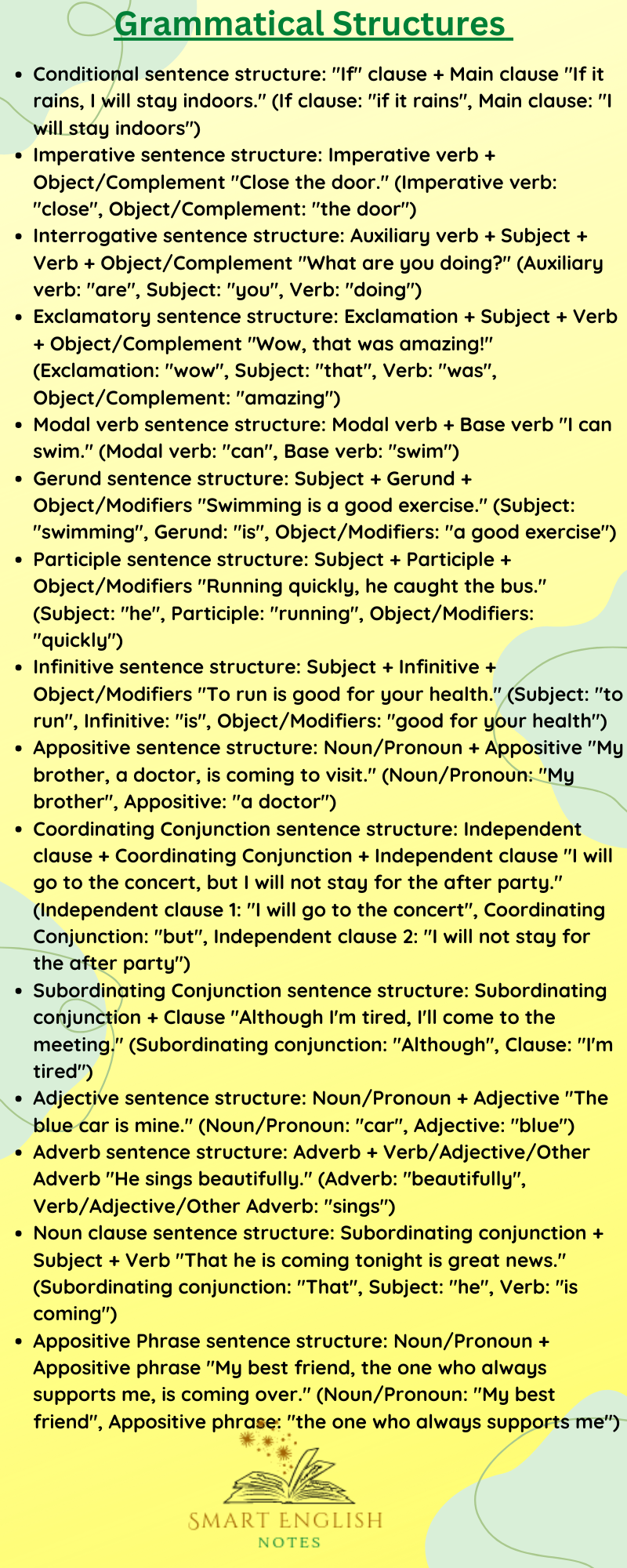
- Conditional sentence structure: “If” clause + Main clause “If it rains, I will stay indoors.” (If clause: “if it rains”, Main clause: “I will stay indoors”)
- Imperative sentence structure: Imperative verb + Object/Complement “Close the door.” (Imperative verb: “close”, Object/Complement: “the door”)
- Interrogative sentence structure: Auxiliary verb + Subject + Verb + Object/Complement “What are you doing?” (Auxiliary verb: “are”, Subject: “you”, Verb: “doing”)
- Exclamatory sentence structure: Exclamation + Subject + Verb + Object/Complement “Wow, that was amazing!” (Exclamation: “wow”, Subject: “that”, Verb: “was”, Object/Complement: “amazing”)
- Modal verb sentence structure: Modal verb + Base verb “I can swim.” (Modal verb: “can”, Base verb: “swim”)
- Gerund sentence structure: Subject + Gerund + Object/Modifiers “Swimming is a good exercise.” (Subject: “swimming”, Gerund: “is”, Object/Modifiers: “a good exercise”)
- Participle sentence structure: Subject + Participle + Object/Modifiers “Running quickly, he caught the bus.” (Subject: “he”, Participle: “running”, Object/Modifiers: “quickly”)
- Infinitive sentence structure: Subject + Infinitive + Object/Modifiers “To run is good for your health.” (Subject: “to run”, Infinitive: “is”, Object/Modifiers: “good for your health”)
- Appositive sentence structure: Noun/Pronoun + Appositive “My brother, a doctor, is coming to visit.” (Noun/Pronoun: “My brother”, Appositive: “a doctor”)
- Coordinating Conjunction sentence structure: Independent clause + Coordinating Conjunction + Independent clause “I will go to the concert, but I will not stay for the after party.” (Independent clause 1: “I will go to the concert”, Coordinating Conjunction: “but”, Independent clause 2: “I will not stay for the after party”)
- Subordinating Conjunction sentence structure: Subordinating conjunction + Clause “Although I’m tired, I’ll come to the meeting.” (Subordinating conjunction: “Although”, Clause: “I’m tired”)
- Adjective sentence structure: Noun/Pronoun + Adjective “The blue car is mine.” (Noun/Pronoun: “car”, Adjective: “blue”)
- Adverb sentence structure: Adverb + Verb/Adjective/Other Adverb “He sings beautifully.” (Adverb: “beautifully”, Verb/Adjective/Other Adverb: “sings”)
- Noun clause sentence structure: Subordinating conjunction + Subject + Verb “That he is coming tonight is great news.” (Subordinating conjunction: “That”, Subject: “he”, Verb: “is coming”)
- Appositive Phrase sentence structure: Noun/Pronoun + Appositive phrase “My best friend, the one who always supports me, is coming over.” (Noun/Pronoun: “My best friend”, Appositive phrase: “the one who always supports me”)